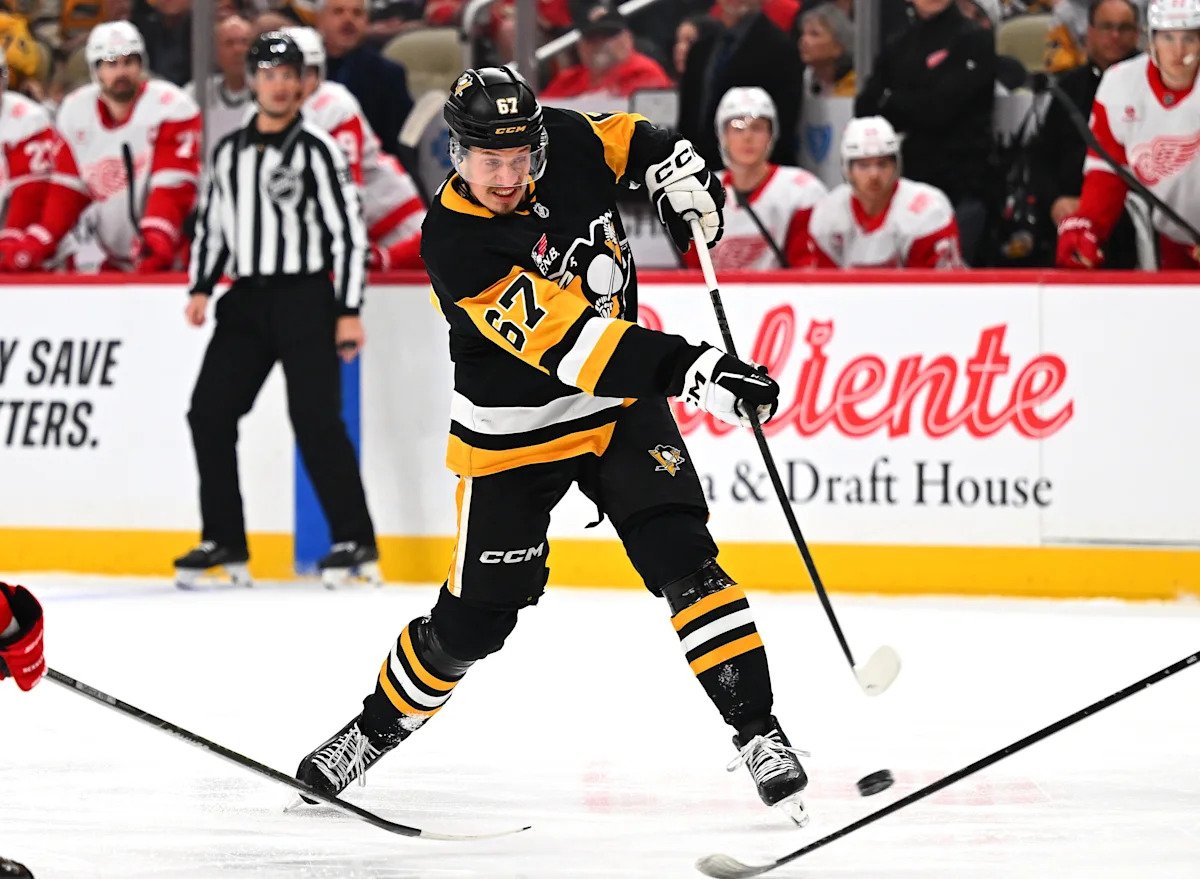
There is still a debate raging as to whether or not the Pittsburgh Penguins are actually trying to rebuild, or if they are instead trying to maintain some level of competition as long as Sidney Crosby is still on the roster. I am still of the belief that they are, in fact, rebuilding, and they are very clearly telling you that with how they are doing business at the moment.
I have made this argument here before, and for the purposes of this article, will make it again.
Advertisement
It’s not a full-scale, tear it all down to the ground tank-job of a rebuild, and maybe you disagree with that and think that it should be. I have grown far more skeptical of those sorts of rebuilds in the current NHL landscape and how successful they can actually be, but that’s another argument for another day.
But it is still very much a long-term approach and rebuild happening right in front of you.
Teams that are not rebuilding do not go into a season with around $10 million in salary cap space. The only teams in the league with more salary cap space this season, as of this moment, are the Columbus Blue Jackets, Philadelphia Flyers, Calgary Flames, Vancouver Canucks, Seattle Kraken, and Detroit Red Wings. The Blue Jackets are going to blow past them in the coming weeks when Adam Fantilli signs his new deal.
The Flyers would have blown past them had they successfully pulled off the Leo Carlsson offer sheet.
Advertisement
Calgary and Vancouver are very much deep into rebuilds.
Seattle and Detroit are both just a mess. I’m not sure what either of those teams are doing, and I’m not sure they know, either.
Teams that are not rebuilding do not make 19 draft picks over the most recent two-year stretch, including seven in the first two rounds and six within the top-40.
Teams that are not rebuilding do not have 10 picks in the first two rounds over the next three years.
Do you know how many other teams in the NHL have 10 picks in the first two rounds of the next three drafts right now?
The answer is zero.
The only other teams that have even as many as eight picks in those rounds are the Calgary Flames, Vancouver Canucks and New Jersey Devils. All three of them have exactly eight picks, while Calgary and Vancouver are, again, very much deep into rebuilds.
Advertisement
They have very few long-term commitments under contract on the roster, while no team has less salary cap commitments over the next three years than the Penguins. And it’s not even particularly close, either.
The players they are acquiring are either short-term reclamation projects on one-year deals (Anthony Mantha, Andrei Kuzmenko types), veteran players that come with additional draft picks (think Kevin Hayes, Connor Clifton and Matt Dumba type trades), or younger players in their early-to-mid-20s that need a change of scenery or have not yet fully reached their potential. They are lottery tickets.
They are telling you what they are doing without actually coming out and saying it.
One of the most important rules in sports is to believe what teams do, and not what they say.
Advertisement
But the big question that remains with all of this is this: If they are rebuilding, why are there still so many older players on the roster?
As is the case with a lot of situations in life, the most likely explanation is also probably the simplest explanation.
Sidney Crosby, Evgeni Malkin and Kris Letang are still here largely because they are legacy players and franchise icons. Whether it’s right or wrong, whether you agree with it or not, the Penguins have decided as an organization that it is important to keep them here. It certainly makes it harder to bottom out for draft position, but as noted above, it does not stop them from focussing on the future in literally every other area.
Even that doesn’t really explain why players like Rickard Rakell and Bryan Rust are still here.
Advertisement
That also (probably) has a very likely, and very simple explanation — nobody else wants them.
More accurately, nobody else wants the type of players they are, that are signed to the type of contracts they are currently signed to.
Are they still good players, and productive players? Absolutely they are. Could either one of them help a lot of teams right now? Absolutely they could. If I were a floundering team full of losers and underachievers that can’t break through, I’d probably love to have a guy like Bryan Rust on it given type of player he is and the type of winner he’s been.
But I’m not an NHL general manager.
Advertisement
The problem is that when you trade for a player, or acquire a player, you are not just acquiring their current level of play and current level of production. You are acquiring their age, their injury history, their position, their future production and, perhaps even most importantly out of all of that, their contract. It is the total package.
And that is where I see an issue regarding the trade values for Rakell and Rust.
As good and productive as they still are, look at the type of players they are. Look at where they play. Look at their contracts.
They are fringe first-second line wingers, in their mid-30s, with term remaining on their contracts.
Advertisement
That is not the type of player that teams are trading for right now. It is not the type of player teams are trying to jump through hoops to acquire. And my argument for that is everything we have seen happen across the league over the past two years.
I went back to the 2024-25 trade deadline, up through the current point of this offseason, and looked at every NHL forward that has been traded over that time, and specifically looked for forwards age 32 or older.
Players that fit Rakell and Rust’s player profiles are almost non-existent on the list.
Some numbers and names:
-
There have been 31 forwards age 32 or older traded over that time period, which does seem like a lot, and should indicate some sort of market for players like Rakell and Rust. But….
-
Of those 31 forwards, 21 of them were either entering the final year of their contract as an offseason trade, or were already in the final year of their contract as a pending unrestricted free agent or rental. There was no long-term commitment with them. Rust and Rakell both have two full years remaining, and had even more going into last season and into the previous trade deadline. Teams don’t want term on older players.
-
Of the 10 forwards in that group that were traded, only 10 of them had multiple years of term remaining on their contract. Which, again, might indicate some sort of value. BUT…
Think about that list of names.
Advertisement
Look at them.
Study them.
Picture them in your head.
Imagine for a second where they are playing on the ice.
Find the common denominator.
Look them up if you want to confirm it.
Or just let me tell you that EIGHT of them are primarily … centers.
The only two mid-30s forwards, with term remaining, that are primarily WINGERS, that have been traded over the past two-plus years are Palat and Kreider.
In Palat’s case, it was a strict salary dump that saw the Islanders trade third-and sixth-round picks along with him to get his contract off the books. Is that what the Penguins should be doing? That’s not a rebuilding move.
Advertisement
In Kreider’s case, the Rangers traded a fourth-round pick along with him to acquire a third-round pick (they basically moved up 15 spots in the draft) and a mid-level prospect. Not exactly a meaningful return or one that is screaming with value. That’s probably the type of return you’re looking at here. Is that worth it? Does that make sense?
Positional value matters, and it matters a lot. It’s a lot easier for a contending team to find a veteran player on the wing that can score you 25 or 30 goals than it is to find a center that can play meaningful minutes. You don’t need to trade assets for the former. Or take on term. Not when you can sign a player like, say, Anthony Mantha for two years and keep your other assets.
The center market is dramatically different, both in terms of the impact they can make, and the availability of them.
Looking back at everything regarding Rakell specifically in hindsight, and I would argue they might have given him such an extended run at center this season not only because of injuries on the roster, but also as a means of trying to boost his trade value. Especially when he started getting work at center in training camp and the preseason before the in-season injuries at the position started to build.
Advertisement
It’s a young man’s game, and teams clearly value younger players in trades, whether they are fully proven or not. Just because teams are throwing around multiple first-round picks for players like Mason McTavish or Simon Nemec does not mean they are going to value players like Rakell or Rust the same way, even if the latter players might be (or are) better right now. You’re just not going to get much in a trade for a mid-30s winger signed for multiple years. Nobody is. Nobody does. You can not force another team to take your player just because you might want to move them.
You might not be able to move them until next year.
If at all.
That might just be the nature of the beast in the NHL right now. It might have to be the reality of the Penguins rebuild.

