Uncharacteristically losing his cool, Jonas Vingegaard gestured angrily at a television motorbike to move along and leave him alone. A late incident on stage five of this year’s Tour de France, had left the two-time champion scrabbling for a bike change, and his desire to avoid the camera’s gaze while drafting cars back to the peloton was understandable. But that flash of frustration served as a reminder that motorcycles have become an enveloping swarm around the Tour de France peloton.
There are as many as 100 motos on the road on each stage – an armada that has expanded to feed the demand for multi-angle live broadcasting, with around 45 camera bikes, and at least as many police escort and support motos. Conflict is inevitable. While they haven’t caused any major controversies so far in this year’s race, this sheer number of motos presents hazards, influences aerodynamics – and you wouldn’t bet against such incidents cropping up in the days to come.
“It would be nice not to worry about it, but it’s a big problem, for sure,” said Lidl-Trek’s Toms Skujiņš.
Latest Videos FromCycling Weekly
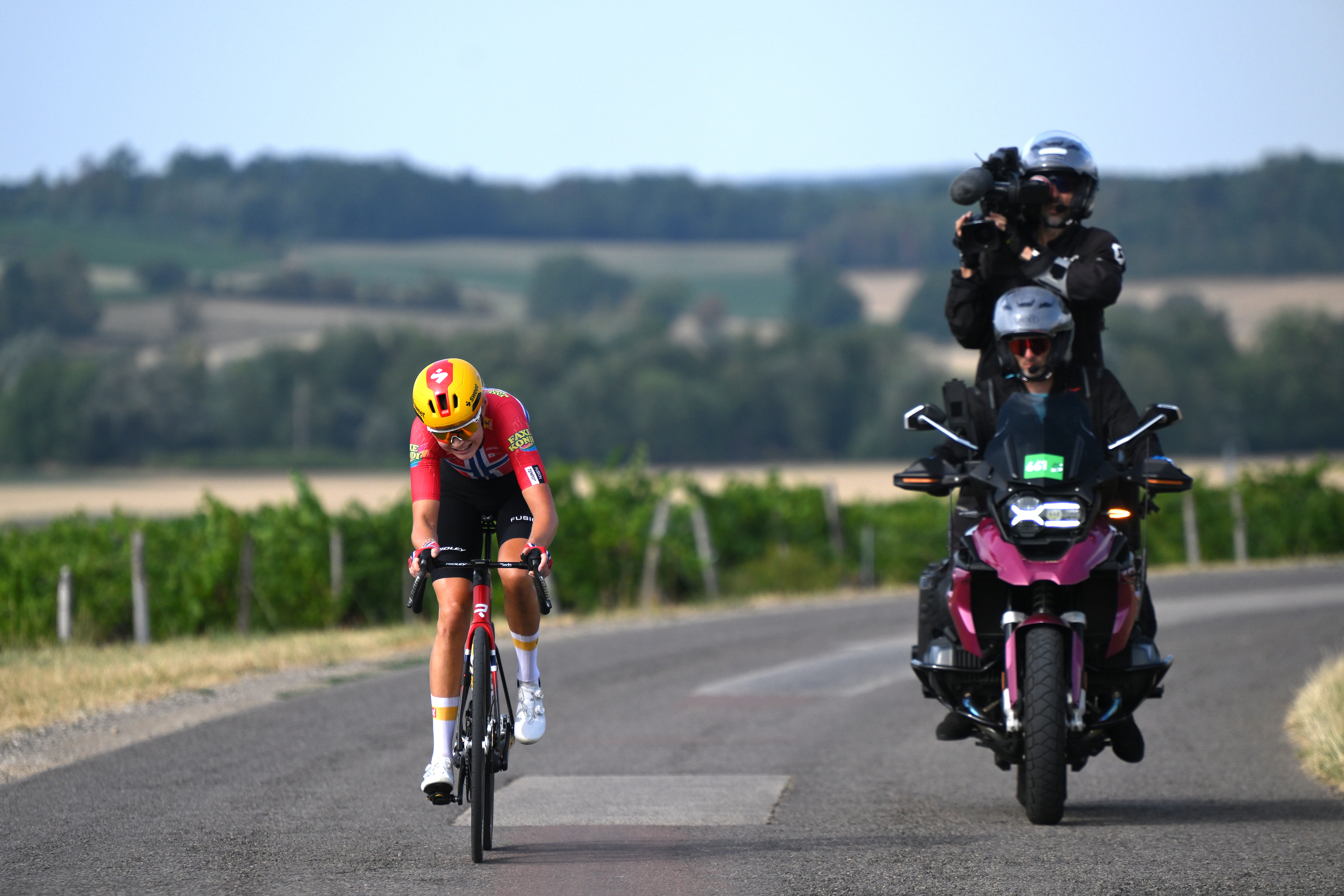
The issue at hand is almost as old as bike racing itself, but it has become increasingly pronounced in recent years: TV motorbikes getting too close to riders and creating a slipstream effect that has a real, sometimes even decisive, influence on the racing.
This is no occasional problem: it happens on each and every stage of the Tour de France, multiple times. Camera bikes frequently hover just in front of a breakaway, a solo attacker or the peloton. The benefit cannot be overstated: the effect is big enough to alter the outcome of the race.
A 2020 study by engineering professor Bert Blocken of Heriot-Watt University, Edinburgh, found that a motorbike sitting 10m ahead of a cyclist – and they are often much closer – reduces drag by 23%. This translates to an 8.9% speed increase, or a saving of 5.4 seconds per kilometre – 4kph of free speed at 54kph. Anyone benefitting from this effect is therefore much, much harder to catch. Conversely, if the peloton is the beneficiary, they are able to close the gap to the tête de la course much more easily.
(Image credit: Shutterstock)
Cycling Weekly contacted the UCI about this issue, but in response it referred us only to its rulebook – in which it is stated that a motorcycle “must operate from three-quarters in front of riders and must position itself on the opposite side of the wind in order not to provide a draft… nor allow riders to benefit from their slipstream.”
The rulebook emphasises that the motorcyclists “must carry out their work without disturbing the proper functioning of the race.” The vagueness is the problem here: how close is too close when it’s not specified in the rules?
It is generally accepted that a moto shouldn’t be within 10m of the racing, but it’s an unwritten rule – and it’s frequently ignored. Too often, as we’ve seen in this Tour de France, a motorbike loiters too close to riders, providing a pronounced aerodynamic benefit – as big a boost as a brisk tailwind. Following a motorbike at a distance of five metres, a rider’s speed increases by 15 seconds per kilometre. It’s a major advantage.
The aforementioned study from Blocken et al proved that even at greater distances there is a slipstream effect. At 30m, the following riders gain 2.7 seconds per kilometre, while at 50m it’s 1.6 seconds. A similar study by the same author, published three years later, determined that the effect of camera bikes can be even greater than that of cars. “A motorcycle with two persons sitting upright is a less aerodynamic object than [a] car. This leads to a larger benefit for the cyclist behind the motorcycle,” the report concluded.
“It’s not on the riders, you’d be an idiot to move out of the draft”
Multiple variables affect how much influence a motorcycle has on a following cyclist, not least the road’s gradient, the speed, and the direction of the wind. But the summary of Blocken’s 2020 report stated: “The common concern in the cycling community that drafting behind motorcycles can influence the outcome of races is correct.” Riders at the Tour wholeheartedly agree.
NSN’s George Bennett, riding his sixth Tour, describes the feeling of being in a moto’s draft. “You don’t really feel it, as you’re still pedalling fast and pushing the same power, but you do notice that you’re going really fast,” he says. “You’ve also got to remember that one or two kilometres per hour faster is huge – it’s such a big margin. Suddenly gaining 10 watts is quite a big difference. In a sport of millimetres, all of these small things make a big difference.”
In Bennett’s view, it’s an issue that tends to favour the breakaways more than those fighting for overall victory at the end of a stage, but still has a significant effect on the race. “There are examples where it’s really bad,” he says, “[including] some obvious cases in the Giro d’Italia where the peloton were pulling death turns and not getting anywhere. And at the Tour de Romandie, life at the back of the peloton wasn’t fun.”

(Image credit: Getty Images)
Like others we spoke to for this feature, Bennett points to Italian races as the worst offenders. “I’m sure this will be a hot topic this Tour,” adds the New Zealander. “But it’s not a new topic – it’s been around forever.”
Complaints from the peloton about the proximity of motorbikes have become increasingly common in recent years, but Bennett admits it works both ways: riders go out of their way to capitalise on the slipstream. “You want to be the guy who attacks first because you know you’re going to get a draft from the bike,” he says. “I’ve benefitted hugely from motorbikes myself.”
He is unequivocal about where the responsibility lies. “It’s definitely not at all on the riders – you’d be an idiot to move out of their draft – it’s on the motorbikes. I even know stories of Belgian ex-team-mates who have talked to motorbike drivers and made friends with them because it can really affect the race.”

(Image credit: Getty Images)
View from the moto
At the Tour de France there are four types of motorbikes: stills photographers, TV camera bikes, in-race bikes, which give time gaps and bidons to riders, and police. Luke Edwardes-Evans piloted a motorbike at the Tour for five years in the 2010s, riding for photographer Graham Watson and snappers from L’Équipe.
Edwardes-Evans explains that it’s the TV motos that cause almost all of the issues at races – not least because they’re the ones permitted to stay close to riders. “They’re big bikes with big panniers and a guy on the back standing up holding a camera. It creates a big pocket of air behind those bikes,” he explains.
As an experienced moto rider, Edwardes-Evans has a theory why it’s become more of a hot topic. “Cyclists are so aerodynamic now and speeds are so fast that the tiny bit of favourable air makes a big difference. It means camera bikes should probably have to stay further and further away. But the public want a good image of the front of the race, so unless the technology catches up in terms of lenses and stability, then it’s difficult to see things changing very much.
“Moto drivers on the Tour are all really experienced, and they know what a safe distance is, but I don’t think a minimum distance rule would be very beneficial. It would still require a judgement. If the minimum were 20m, how to measure it? Trying to gauge how far away you are when you’re riding a motorbike isn’t easy.”
What, then, is the solution? Some have suggested equipping motorbikes with lasers to project a ‘distance bubble’ on the road, while others have called for more side-on filming (though Blocken notes this would still provide an aerodynamic effect). The use of drones – as seen at Milan-San Remo and in numerous cyclo-cross races – has also been proposed. However, the most popular idea is enforcing a minimum distance rule of 25m. Blocken points out that the challenge is to ensure the camera motos can still do their job effectively. “From 100m away, on a winding road, the camera won’t see the rider.”
So what does he think should be done? “The best that can be done, while we’re waiting for drones to become practical, which could be decades, is setting some minimum distance rules. The cameras nowadays are highly advanced and they can record high quality footage 30-40m away.” One even simpler solution from Blocken is to reduce the number of motorcycles allowed in front of the racing. “We often see multiple motorcycles together in front of a group,” he says. “At most there should only be one motorcycle.”
When Blocken first published a study into the advantage motorbikes provide to following riders in 2017, the UCI was initially dismissive of his work. “The UCI technical director said it’s just a load of nonsense,” he recalls. Since then, the governing body has been more open to working with Blocken, and in 2023 it extended the minimum distance a following team car must remain behind a rider in a time trial from 10m to 25m. Blocken doubts this rule is enforced, and no such action has been taken in road races.
Even if the UCI eventually introduces new measures, Skujiņš warns that the real challenge will lie in enforcement. “A lot of the times we tell the race commissaires that the moto is too close. It might go away for five minutes, but then it’s back five minutes later,” the Latvian says. “We also need to educate the drivers and cameramen that they can’t sit close to the rider.” It’s an issue guaranteed to rear its head repeatedly at this year’s Tour – and one that shows no signs of being resolved any time soon.
Explore More

